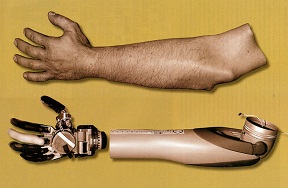

New Prosthetic Technology Connects Brain to Artificial Limb Like Never Before
Researchers Aim to Completely Replace Lost Limbs
We talk a lot about computers and video games here at Tech Serious, and for good reason: they make our lives easier, and more interesting. But if there was one form of technology that really was 'seriously' useful, it would be prosthetic limbs. And it just so happens that American scientists have recently taken a major step forward towards their ultimate goal of effectively replacing the lost natural limb.
Right now researchers at John Hopkins University and the University of Pittsburgh are working on a prosthetic limb that wouldn't just give back amputees mobility in their fingers, elbows, knees and toes, but would also offer them the ability to sense pressure, touch, vibrations and even temperature. In total, the technology is reported to give users twenty-seven degrees of mobility.
The project, which is being funded by the United States' Department of Defense's Defense Advanced Research Projects Agency (DARPA), provides the first prosthetic that effectively connects the brain to a new limb through a computer interface. Tiny chips are implanted into the brain in order to complete this connection, which is currently being tested on a number of subjects at the University of Pittsburgh.
So far, the results have been extremely encouraging. One test subject, a quadriplegic named Tim Hemmes, was able to demonstrate the technology by high-fiving his girlfriend. With his body devastated by a motorcycle crash seven years ago, Hemmes said it was the first time since the accident that he has experienced such mobility in his limbs.
"I put my heart and soul into everything they asked me to do...I got to reach out and touch somebody for the first time in seven years," Hemmes said.
According to researchers at the University of Pittsburgh's Medical Center, the next step in the project will be to use five volunteers suffering from spinal cord injuries to study how these prosthetics work in real-world situations.
DARPA documents indicate that the agency believes this technology will not only help victims of devastating automobile accidents (like Hemmes) but could also aid people who suffer strokes or neurological disorders. The Federal Drug Administration recently launched a special review program of the technology that could help to fast-track the process of bringing these devices to the public.


Comments (0)